Conformation Showing Guidelines
General
This document intends to serve as a guide to what Conformation showing within UKC is, and how it differs from Classic showing. Conformation intends to mimic real-life pet showing, where animals are judged based on how well they adhere to shape and colour specifications set out in breed standards. Pets are first shown in individual breed rings, where they compete against other animals of the same breed. The winners of these then go on to compete in the group rings, where they compete against other animals in the same group (i.e. gundogs, hounds, oriental cats, etc.). Finally, the winners of the group ring go on to compete against each other for Best in Show. This final ring is still split by species.
Currently, UKC has a 5 petz per breed per show breed cap, meaning that you can enter up to 5 petz of the same breed in one show. However, you may register as many petz of the same breed as you wish to! Only A-registered petz may compete in Conformation shows.
Unlike PKC, UKC does not require users to take a new photo for each judge's show. You may use the same pose for as many shows as you'd like. However, it is not a requirement to stick with the same pose - if you'd like a greater challenge, you are welcome to continue taking new ones!
Conformation vs. Classic
On the sidebar under 'Conformation', you can find the pages which detail conformation placements and points, show types, the breed standards and the standard definitions (for colours and patterns), as well as any miscellaneous guides.
Conformation differs from Classic mainly by how the petz are judged. In Conformation, the pet's adherence to the breed standard (i.e. its appearance) is important. Judges are looking for petz that fit the breed standards in both colour and patterns, as well as petz that are posed well ('handled well'). Shape and structure of the animal, and how this matches the breed standard, is important in real life conformation, however due to different files and file types (e.g. petzy, showy) being accepted for each breed, this cannot really be mirrored in petz conformation. You can consider the quality of the pose to be a replacement for the shape and structure of the pet. In short, in petz conformation shows, a judge is looking for both a pet that fits its breed's standard in both colours and patterns well, that is also posed well.
Preferrences, Faults, and Disqualifications
In each breed standard, there will be a section on the right that details what is faulted in that breed, as well as what is disqualified. On the left within the actual breed standard box, there might also be mentions of certain colours or patterns being preferred or less preferred. Below are more details on what these mean, and what they mean for the pets you are showing:
Preferred/less preferred
Essentially what they sound like. Certain breed standards may list, for example, that a certain degree of white is preferred - in practice, this would mean that if two petz were posed identically, and one showed the preferred degree of white whilst the other showed a different, accepted and non-faulted degree of white, then the pet that shows the preferred degree of white would place over the second pet. Similarly, in a breed standard where a certain degree of white is noted as 'less preferred', this would mean that with two petz with identical poses, where one pet showed an accepted and non-faulted degree of white, and another showed an accepted yet 'less preferred' degree of white, the first pet without the 'less preferred' degree of white would place over the second pet with the 'less preferred' degree of white. A preferred pattern/colour is preferable to any other colour/pattern listed in the breed standard, and a less-preferred pattern colour is less preferable to any other colour/pattern listed in the breed standard, but a less preferable colour/pattern is still preferable to a faulted colour/pattern.Faults
More detrimental to a pet placing than something that is less preferred. Mismatched pigment (e.g. a dog with a black nose on a blue coat in a breed that allows both black and blue coat colours) or eye colours (e.g. a dog with black pigment but with gold eyes, where gold eyes are only allowed in dogz of that breed of blue pigment) are a fault even if not stated in the standard, provided that the mismatched pigment/eye colour is also accepted in the breed. If the colour is not accepted, it is a DQ. Some breeds may have more specific faults, which are always listed in their breed standards on the right. Incomplete patterns or missing markings may also constitute faults, and information on this can be found on the standard definitions pages.A pet that is faulted is still A-registerable, yet will likely struggle more in the show ring when it comes to placing, especially in larger breed rings. In two petz with identical poses, where one has an accepted, unfaulted eye colour, and the other has a faulted eye colour, the first pet is almost guaranteed to always place over the second. However, with a really good pose, it is still possible for faulted petz to place and be competitive in the ring.
Disqualifications
These mean that a pet is not A-registerable. A disqualification is any colour or pattern that is not listed in the breed standard, and patterns that do not follow the standard definitions (e.g. horizontal tabby striping on a cat's body). Some breeds may also list additonal disqualifications - these can be found on the right of the breed standards page. Breed standards will usually list 'wrong eye colour/nose colour' as a fault - however for a pet to be faulted, the eye colour must still be listed in the breed standard. If a pet has an eye colour not listed in the breed standard atall (e.g. pink eyes), then it is a disqualification. Disqualified petz may not compete in conformation shows.If a standard or pattern has specific requirements (e.g. in tan-pointed dogz, where not covered by masking or white markings, tan eyebrows should be present), it is best practice to hex these markings so that they are clear and visible in pose. Similarly in files that are prone to awkward ball rolls that hide required markings, it is recommended that you get a pose that does show the required marking clearly.
We also recommend for both the registration process and whilst showing that you add the pet's colour and pattern in their bio on their UKC page - for example, if I had hexed a chocolate mink cat with trim white, I'd add 'chocolate mink w/ white trim' to his bio. This is particularly helpful when using palettes, as judges will not necessarily know what colour you are aiming to represent, but if it's written down, they can search for real examples to determine how well they think it matches.
UKC Stewards have everyone's best interests in mind when it comes to registering petz as A-reg for conformation - if a pet is declined, the steward who declined them will always leave a note regarding why they are not A-registerable. Stewards are also always happy to help when it comes to hexing and registering petz for conformation - if you have any questions or clarifications regarding breed standards, standard definitions, or the registration process.
Pose Types
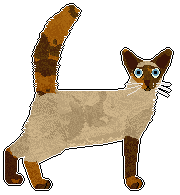
Catz are quite easy when it comes to deciding which pose type to use, as only the standard catz pose is permitted in Conformation. Siamese poses (stretched or sitting), or any other poses or stances, are not permitted in conformation.
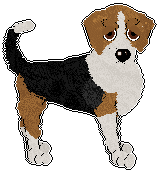
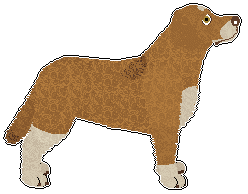
However, when it comes to dogz, three pose types are permitted in Conformation - dali (front), dane (profile) and 3/4 poses. Different files look better in different poses, and UKC's guidance on pose type is to experiment with different pose types to see which pose you think suits the file you are showing the best. Pose critique can always be sought in the 'pose-critique' channel of the Petz Life discord server. Poodle poses, or any other poses or stances, are not permitted in conformation unless mentioned in the breed's standard.
 |
 |
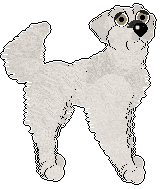 |
| A dali (front) pose | A dane (profile) pose | A 3/4 pose |
Prefixes
It is up to individuals how they want to use prefixes for their petz. You may choose to have different prefixes for different breeds, groups, or species. When it comes to showing petz hexed and bred by people other than yourself, you must follow their prefix rules.
Prefixes for showing on PKC used to work slightly differently than how a lot of us are used to using prefixes in other parts of the Petz community, as PKC aimed to mirror how prefixes work in real animal conformation showing. You are probably used to including the hexer/breeder's prefix in the showname of your petz, regardless of whether the petz are hexed 1st gens or bred multi-generation petz. On PKC, it was common practice for bred multi-generation petz to include the breeder's prefix, but for 1st gen hexed petz to just use the owner/handler's prefix, representing foundation stock for the owner. The hexer would then be listed in the pet's profile. Whatever rules you decide to have for your prefixes, we recommend including your prefix rules for each of your prefixes in their respective prefix description sections of your UKC profile, allowing other users can easily find and follow your rules.