Tan Points
General
Tan is red pigment at set positions on a dog. The pigment starts at set points and can be present as a small amount or spreading over larger areas. The degree of spread determines what type of tan pattern it is. Some breeds allow all tan patterns, other breeds only allow a certain tan pattern. Check the standard for which.
'Traditional' Tan
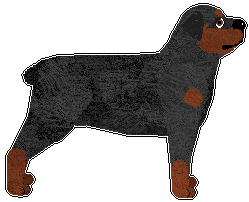
'Traditional' is a colloquial term for the classic tan-pointed dog. It is the tan pattern typically seen on, for instance, the Rottweiler or Dobermann. The tan points and are placed as follows:
Required Markings
- On the lower muzzle: Minimum is jowls, chin, and along the sides of the muzzle. The cheeks may be tan, either as a small spot on each cheek, as a partial marking, or covering the whole cheek. The throat area below the chin may be tan. Base-coloured paintballs may be placed on the tip of muzzle (surrounding the nostril area) to represent fainter muzzle markings
- On the paws and lower legs
- Minimum amount on the legs: Forelegs - up to and including the wrist. Hind legs - up to but not including the ankles
- Maximum amount on the legs: Forelegs - up to but not including the elbows. Hind legs - up to but not including the knees
- Paintballs may be used to get a line of tan on the elbows and/or the knees, and/or be placed on the wrists/ankles. Tan on adjacent leg feathering may be higher or lower than on the leg itself to mimic the effect of different real-life coat types, providing it does not look completely disconnected. For forelegs, this feathering tan can extend up to the elbows. For hindlegs, this tan can extend up to halfway between the hip and ankle (i.e. the level of the knee)
- Above the eyes as dots: Note - in dane pose, the eye spots can be hard to see, or appear absent in certain files. Furthermore, in certain files (for example, the Abno Aussie) in dali/front pose, the eye spots/eyebrow balls may 'roll' and be completely invisible. UKC accepts dogz where this is the case, though for registration, please photograph the dog with the eyespots visible
- On the front of the chest as two smaller spots: In dogs with predominantly white chests, this marking may be partially obscured, or not visible atall - this is completely acceptable
Optional Markings
- Inside the ears
- May be present as a "vent" spot, on the butt beneath the tail and/or the underside of the root of the tail. On longhaired dogs, feathering in this area may be tan as well.
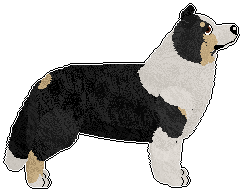
A dog with a vent spot.
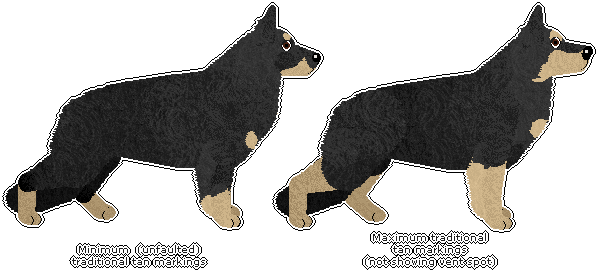
Creeping Tan
Also known as high or running tan in some breeds. This pattern is inbetween Traditional and Saddle tan. It ranges from having a bit more tan than a traditional dog, such as tan elbows, knees, and top of muzzle, to a dog that is almost saddle-patterned.
Minimal creeping: As for traditional tan, but with tan elbows and knees and with or without the tan forming spectacles around the eyes. Some breeds only allow minimal creeping. If the standard does not specify, all degrees of creeping is allowed.
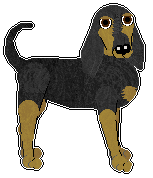
An example of Creeping Tan.
Saddle Tan
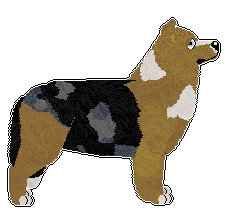
The base colour is tan, with a saddle on the upper body. How large the saddle may vary with individual standards, but generally at least the majority of the belly ball must be non-tan. If nothing else is mentioned in the standard, the saddle may also include the butt, chest, tail (completely or partially), neck, and shoulders and/or hips. There may be small non-tan spots by the base of the head/near the ears.
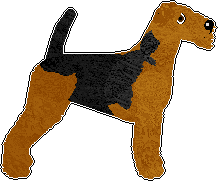
An example of Saddle Tan.
Grizzled Edges
Saddled tan and creeping tan dogs (except dogs with minimal creeping) may have grizzled edges, where the edges of the saddle show up as tipping rather than solid colour. In saddled dogs, this is typically seen on the shoulders/thighs and may also be on the neck, tail, and/or undersides of body. In dogs with creeping tan, it's typically seen on the upper legs where they meet the tan areas.
With Other Markings
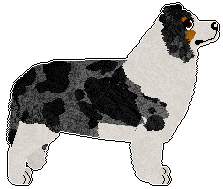
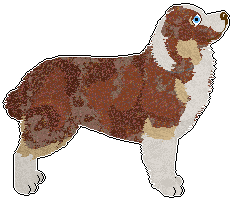
When combined with other coat patterns, tan markings may become partially or completely obscured. UKC applies a 'benefit of the doubt' philosophy when it comes to such cases - for example, if a dog has a predominantly white chest, the tan spots on the chest/shoulders can be missing without fault, as we assume in those dogz that those points are present and just hidden by the white. White may also cover tan markings on the face and legs. Furthermore, in breeds that allow masking, the mask may cover up tan facial markings, and may cover up the tan eye spots - this is allowed without fault.
Otherwise, if required tan markings are missing without being covered up by another pattern, then the dog is not A-registerable at UKC. Previously, PKC allowed dogz with one tan marking missing to be A-registered but faulted, but for the ease of distinguishing between what is a ball roll and what is fault, UKC has decided not to carry this forward. The absence of any required tan marking is a disqualification and not allowed in A-reg dogs. Optional markings are optional and not faulted if missing in any traditional tan-pointed dogz.
Examples of Tan combined with other markings:
 |
 |
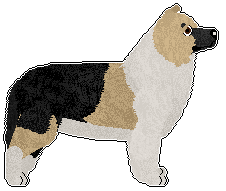 |
| A dog where the majority of the tan markings are obscured by white in the Irish Spotting pattern | A dog where the tan markings on the legs, chest and muzzle are all partially obscured by white in the Irish Spotting Pattern | A dog in the saddle tan pattern where the tan markings on the face are obscured by a standard mask |
Feathering
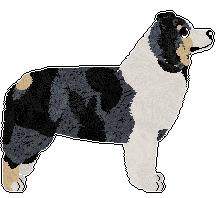
In long-haired breeds, such as the Australian Shepherd and the Border Collie, tan markings may be present on either the front of or whole of the facial feathering behind the cheeks. Extending the cheek tan markings like this is optional. Furthermore, as detailed above, tan markings may be present on leg feathering and may appear higher or lower than the tan markings on the adjacent leg, so long as it looks realistic and doesn't appear disconnected. Tan on leg feathering may extend up to the elbow on the front legs, and up to halfway between the hip and ankle on the hind legs.
|
 |
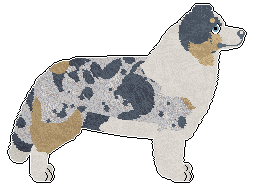 |
| A dog with no tan on the face feathering | A dog with tan, as paintballs, on the front of the face feathering | A dog with tan markings completely covering the face feathering, and with tan extended further up the feathering on the hind leg |
Brindled Points
When brindled points are allowed, the red colour be a red option from the tan or the brindle section.
Examples
 |
|
|
| A solid black dog with tan in the 'traditional' pattern | A blue merle dog with tan in the 'traditional' pattern and white markings in the irish spotting pattern | A slate merle dog with tan in the 'traditional' pattern and white markings in the irish spotting pattern |
 |
|
|
| A blue tweed merle dog with tan in the saddle pattern and white markings in the irish spotting pattern | A red merle dog with tan in the the minimal creeping pattern and white markings in the irish spotting pattern | A solid black dog with tan in the 'traditional' pattern and white markings in the irish spotting pattern |
|
 |
|
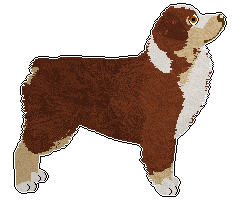
| A solid black dog with tan in the saddle pattern, white markings in the irish spotting pattern, and a standard black mask | A solid liver dog with tan in the 'traditional' pattern and white markings in the irish spotting pattern | A blue merle dog with tan in the 'traditional' pattern and white markings in the irish spotting pattern |
 |
 |
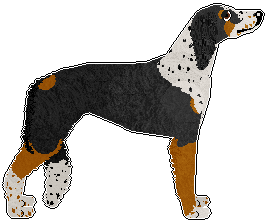 |
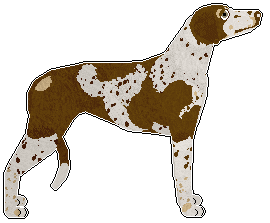
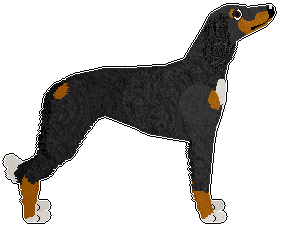
| A solid liver dog with tan in the 'traditional' pattern, white markings in the piebald pattern, with medium ticking present on the white | A solid black dog with tan in the 'traditional' pattern and white markings in the trim pattern | A solid black dog with tan in the 'traditional' pattern and white markings in the irish spotting pattern, with ticking present on the white |
 |
 |
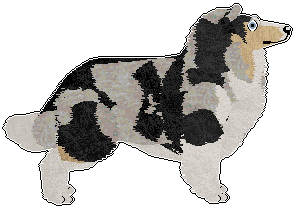 |
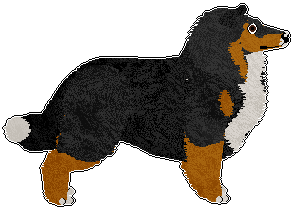
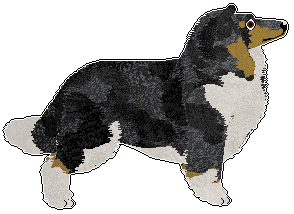
| A solid black dog with tan in the 'traditional' pattern and white markings in the irish spotting pattern | A blue merle dog with tan in the 'traditional' pattern and white markings in the irish spotting pattern | A blue merle dog with tan in the 'traditional' pattern and white markings in the irish spotting pattern |
 |
 |
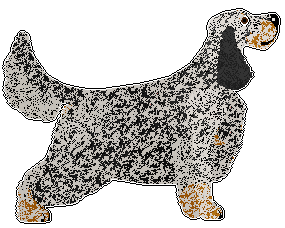 |
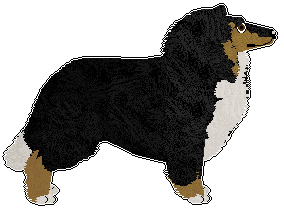
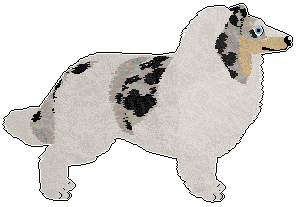
| A solid black dog with tan in the 'traditional' pattern and white markings in the irish spotting pattern | A blue merle dog with tan in the 'traditional' pattern and white markings in the colour-headed white pattern (in dogz that are not Rough Collies, this would class as the piebald pattern) | A solid black dog with tan in the 'traditional' pattern and white markings in the extreme white pattern, with heavy ticking present on the white |
 |
 |
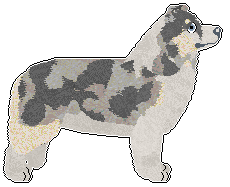 |
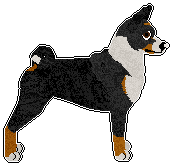
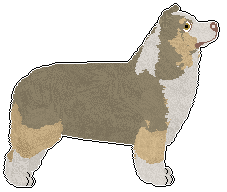
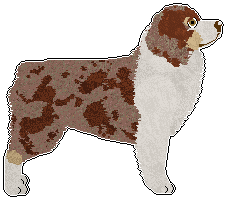
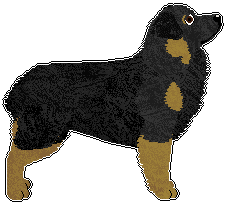
| A solid black dog with tan in the 'traditional' pattern and white markings in the irish spotting pattern | A solid isabella dog with tan in the creeping pattern and white markings in the irish spotting pattern | A slate merle dog with tan in the creeping pattern and white markings in the irish spotting pattern |
 |
 |
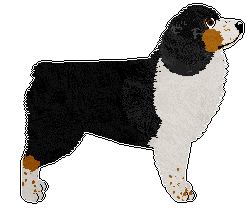 |
| A red merle dog with tan in the 'traditional' pattern and white markings in the irish spotting pattern | A solid black dog with tan in the creeping pattern | A solid black dog with tan in the 'traditional' pattern and white markings in the irish spotting pattern, with light ticking present on the white |
 |
 |
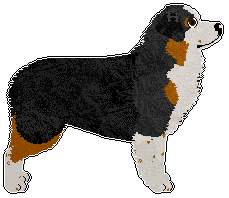 |
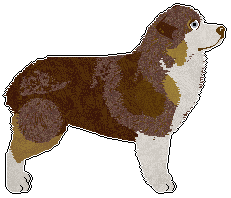
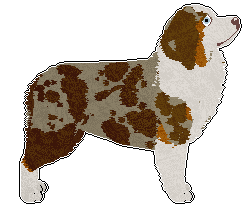
| A red merle dog with tan in the 'traditional' pattern and white markings in the irish spotting pattern | A red merle dog with tan in the 'traditional' pattern and white markings in the irish spotting pattern | A solid black dog with tan in the 'traditional' pattern and white markings in the irish spotting pattern, with light ticking present on the white |